By Bernadette McKendy
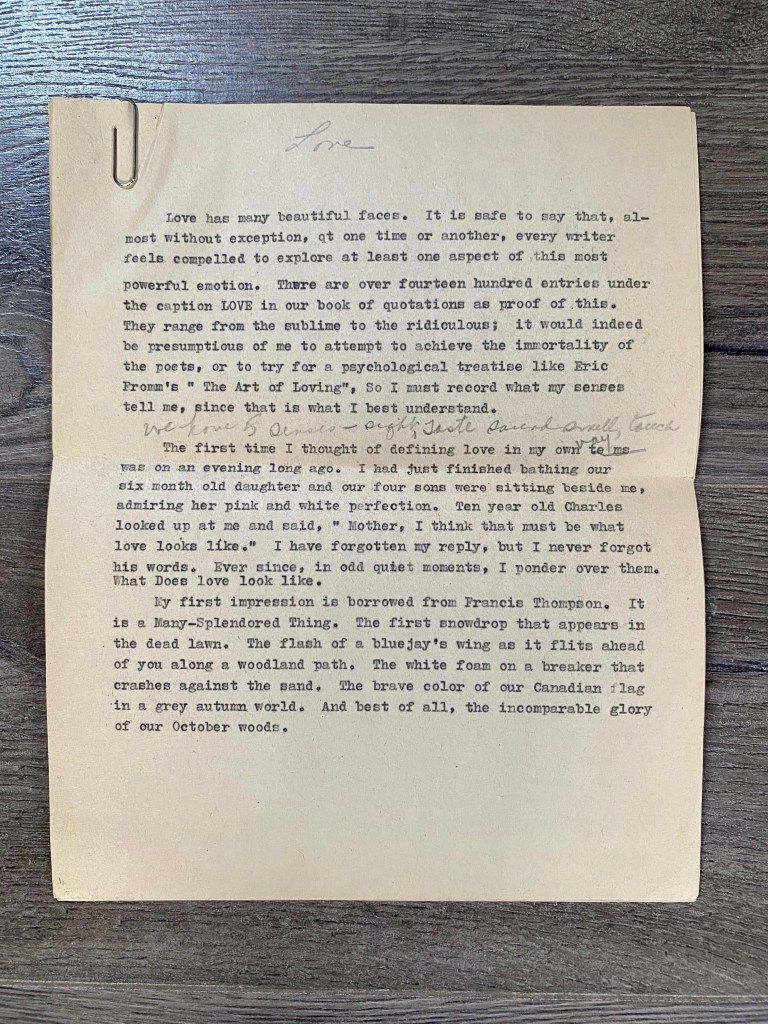
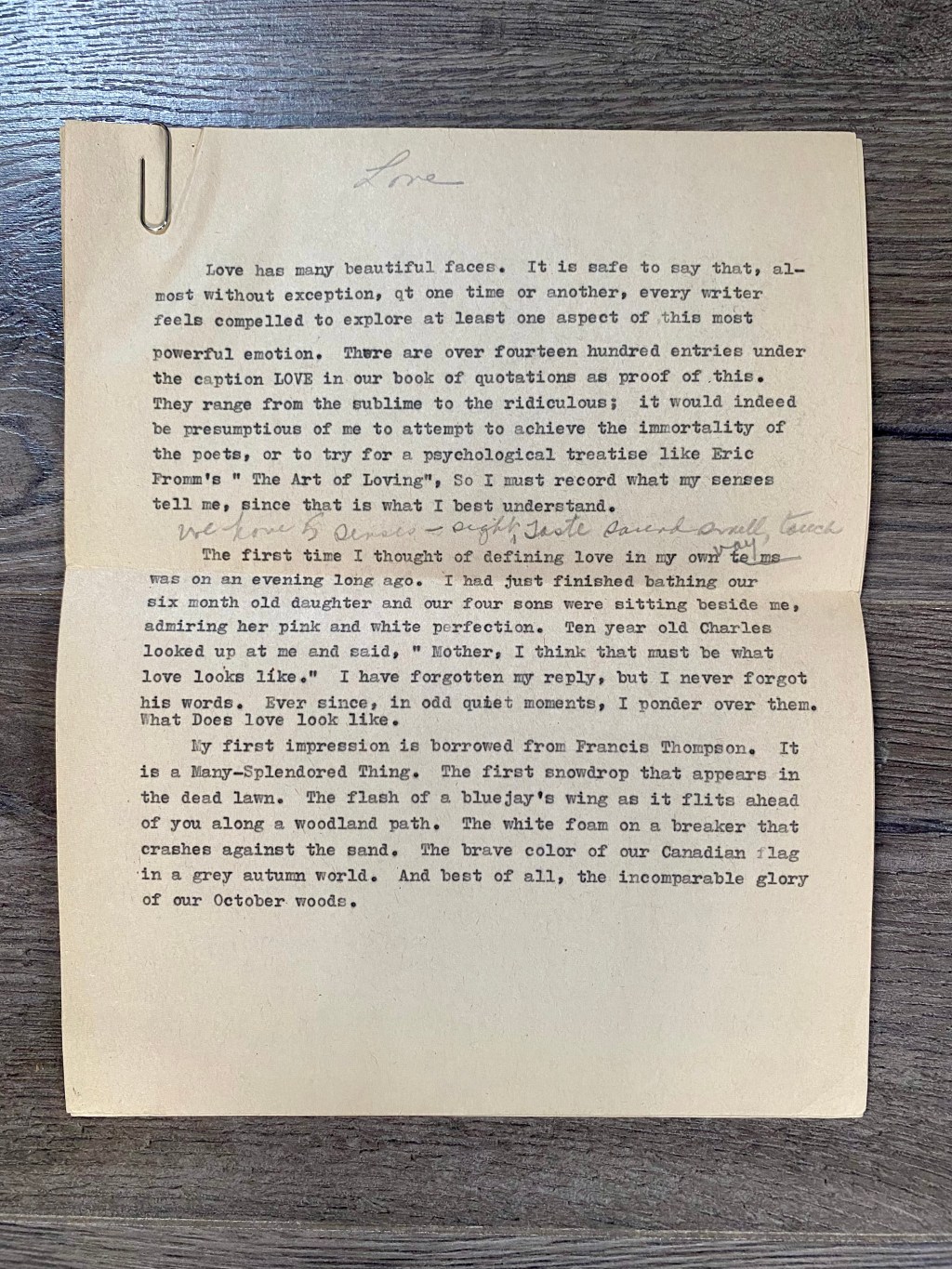
Love has many beautiful faces. It is safe to say that, almost without exception, at one time or another, every writer feels compelled to explore at least one aspect of this most powerful emotion. There are over fourteen hundred entries under the caption LOVE in our book of quotations as proof of this. They range from the sublime to the ridiculous; it would indeed be presumptuous of me to attempt to achieve the immortality of the poets, or to try for a psychological treatise like Eric Fromm’s “The Art of Loving”, so I must record what my senses tell me, since that is what I best understand.
We have five senses – sight, taste, sound, smell, touch. The first time I thought of defining Love in my own way was on an evening long ago. I had just finished bathing our six month old daughter and our four sons were sitting beside me, admiring her pink and white perfection. Ten year old Charles looked at me and said, “Mother, I think that must be what Love looks like.” I have forgotten my reply, but I never forgot his words. Ever since, in odd quiet moments, I ponder over them. What does Love look like?
My first impression is borrowed from Francis Thompson. It is a Many-Splendored Thing. The first snowdrop that appears in the dead lawn. The flash of a bluejay’s wing as it flits ahead of you along a woodland path. The white foam on a breaker that crashes against the sand. The brave colour of our Canadian flag in a grey Autumn world. And best of all, the incomparable glory of our October woods.
What does Love taste like? It is as sweet as wild blackberries, as tart as lemon and as bitter as a lonely tear. It can be as substantial as bread and butter or as elusive as the bubbles in champagne. It may be as exotic as all the spices in the Orient or as homey as a bowl of pea soup.
And what is the sound of Love? It is as gay as a calliope and melancholy as the wind sighing through the pines. It is as compelling as the bagpipes and as soothing as a mother’s lullaby. It is the gentle rippling of the water over the stones at Spring Brook and the mighty roar of the April freshet over the dam a few miles down the river.
When Love speaks, what does it say? King Soloman celebrated Love in his Song of Songs:
“How beautiful you are, my love, how beautiful you are! Your eyes, behind your veil, are doves; your hair is like a flock of goats frisking down the slopes of Gilead. Your teeth are like a flock of shorn ewes as they come up from the washing. Each one has its twin, not one unpaired with another. Your lips are a scarlet thread and your words enchanting. Your cheeks, behind your veil, are halves of a pomegranate. Your neck is the tower of David built as a fortress. Your two breasts are two fawns, twins of a gazelle, that feed among the lilies. You are wholly beautiful, my love, without a blemish.”
How to explain its perfume? Mayflowers and delicate white voilets. The fir tree when it is first brought into the house on Christmas Eve. Newly-turned sods in Spring hint of its promise and the sadly-sweet odour of dying leaves in Autumn recall its fulfillment.
When I reach out to touch Love, what do I find? A baby’s cheek warm with new life and cool from the crisp winer air. Its spirit of adventure and the thrill of its power are there in the grasp of the steering wheel of my little car. I touch Love when I feel the comfort of a friend’s hand, held out in understanding.
There it is. The look, the taste, the sound, the smell, and the feel of Love. Gather it all together – its beauty and sadness, strength and fragility, its familiarity and majesty. Distill it into one small particle of everlastingness. Look upwards to the heavens. There it is. The Evening Star.
 Rethink Rewild Reconnect
Leave a comment